Thursday, December 3, 2009

I must be going for a record or something...

So, another new post.

Today I have to present on ternary (or trinary) computing as opposed to binary computing. Part of the interesting applications have to do with the fact that optical computers (which use photons rather than electrons) could implement ternary systems to make vastly faster computers, because we've almost maxed out what we can make the electron do. We need to branch differently.

Anyway, one of the advantages to optical computers are that the photons would move faster than electrons can in circuits (electrons go much slower than the speed of light when moving through copper, for example). Also, photons have higher bandwidth. I puzzled over that for quite a while.

At first I (for some reason) decided that it must be because photons have more mass. But they're massless (duh). Then I looked into what particle bandwidth is (thanks, wikipedia!) and it basically depends on the spectral linewidth of a particle (in this situation). Since electrons have small linewidths because they move into discrete states and photons have a huge spectrum they can move around in, their bandwidth is greater. See, I was thinking about bandwidth in terms of internet speed and that was my hangup.

Silly me.

Anyway, watch this video, it's GREAT:

Tuesday, December 1, 2009

I'm so unreliable about this...


Okay, so I have been told to update and I have known for a while that it was time to do so, but I've been crazy crazy busy. I still am, actually, but I have decided that this is worthwhile enough to blog about.

Okay, so in my Discrete Structures class (which is killing me), I have been spending the entire semester studying math. I get that it's supposed to be mathy, though, so I accept that for what it is. The problem is the caliber of the problems given the class. The average homework assignment takes me four hours and two trips to o
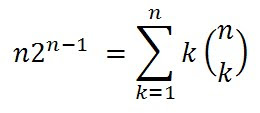
ffice hours. That isn't too bad, but I don't think I'm learning things properly. On the last exam, for example, I got a 50. Out of a hundred. And the class average on the exam was a 50. I would be the type of person to put it all on the professor, but he gave us the option to redo it for half the points we lost, and as I look it back over it seems really simple. For example, the last problem totally stumped me. I just looked at it again, and I could readily see why n*2^(n-1) is equal to the sum of k going from one to n of k C(n,
k). I would format that better, but I don't know how to do so on this. Instead of erasing anything, I'll just go do it in Word and see if I can append it here in that way (starting time 12:37 p.m. EST, let's see how long it takes me to do this in Word).

Well, that took me until 12:51 to do. The new Word makes things hard to find and makes me miss OpenOffice. Ho hum. Anyway, the answer is to use the binomial theorem trickily and then take the derivative of both sides. I won't go into all the details because a) it's boring and b) I'd hate for it to look like I was facilitating plagiarism. Rest assured, though, that it is very provable (laughably so, in fact).


Anyway, there's a really funny show called It Only Hurts When I Laugh, and it's like AFV, but there are more videos that actually make you laugh and people fall down a lot. I like when people fall down, and I don't know why. Look into it. In the mean time, watch this:

Sunday, October 25, 2009

Oh, jeez...

Yeah, it's been a while since I have posted anything, but that's because my life has been a little hectic as of late, with tests and quizzes and whatnot. Even tomorrow I have a stats quiz and a Japanese Kanji quiz. Sometime this week I will also have a midterm for stats, so that is also something I have to look forward to.

But now I have a moment, so I decided to update.

Um, so what's new with me...

Well, I have actually started playing World of Warcraft, haha. I don't play it obsessively (I haven't played in a week, to be honest) and I'm pretty casual about it, but it is a lot more fun than I remember, because the servers aren't as slow and there's tons to do. I've been enjoying that, then.

Also, I think I am all done worrying about anything that will happen after I die. No, really this time. It's totally beyond my scope and outside my domain, so I'm officially letting it go. It doesn't mean I'm happy about it, but what kind of person is?

Also, my good friend Taylor is coming up to visit soon and Michael is supposed to come up to VT in December, so I have that to look forward to as well. Hopefully everything works out so that they can come up and I can see them. It would certainly be nice, as they both go to different schools now and I haven't seen them in too long.

Also, I watched Where the Wild Things Are, and while it was good, it was rather depressing. I had also forgotten how the book had actually ended, and I was a little saddened by the fact that nothing was fixed for the Things at the end of the movie. But hopefully things were on the up-and-up for the Things. But who knows. The movie really played into my mood as of late, which was bizarre and bizarrely comforting. I think.

Also, I have nothing else to say, so I will just post something, I suppose:

Tuesday, October 13, 2009

Existentialism and war.

The two elements of this title are only sort-of related. Don't read too much into it.

Okay, so the ideas of death and dying have been on my mind so much recently. It's a kind of thinking where you get a little nauseated when you ponder things, but I think I have come to the crux of the issue, and here it is:

Eventually, the entire universe will cease to be, and I will have no idea anything happened. The entirety of the many billions and billions of years that will pass will, to me, seem to go in a fraction of a second because I won't be aware. In fact, I won't even know the difference between the universe existing and it ceasing to exist. The transition will be lost on me.

That is a big thought. However, when I stop and consider it, I don't really want to know. I don't want to be around to witness the end of everything. It's like a morbid curiosity. I want to know but if I ever knew I would want to not know. So I think it's for the best that I won't know. Even though it makes me a little sad, I think the knowledge and the weight that would accompany it would make me even sadder. Billions of years elapsed before I was born and that didn't seem to take any time at all, and I don't regret not seeing how it all started, so I guess it's not a big deal that I won't see how it ends.

Don't get me wrong, though. The finality of death is still depressing to me and it does make it hard for me to fall asleep sometimes. If you know me personally, then you know that's pretty big, because I can usually fall asleep in eight seconds. I have lost, as near as I care to figure, 19.5 hours of sleep since last Sunday over this. That is time just lying in bed, thinking about all the time that I won't be able to think.

That's another regret. Losing my ability to think and reason. As a person who loves those two things as much as I do, the thought is heart-wrenching that I will lose both and all my accumulated knowledge.

Anyway, that is all besides the point. I am going to die and I have got to get over it and I won't see how it ends and I have got to get over THAT, too. I guess I'll just try to avoid thinking about it. What will happen will happen, and it will happen that I will cease to happen. Ho hum and that's the end of it. If we all only get one lifetime, I have just got to make sure that I make the most of mine, and sitting around thinking about not having time (since it's a construct that the dead can't appreciate or even notice) is certainly not a good time.

It's late, so forgive my affected speech.

About war, though. War is a way for people to get ahead by killing other people, and I hate it. I am diametrically opposed to violence (not that I have any idea what I mean by diametrically or even what diametrically means. It sounds nice, though.) and I ever take Gandhi's stance about not being willing to kill for any cause (though he was willing to die for many, and I can't say the same.). Societies that use war as a tool are base cultures in my opinion. Violence is, I think, wasteful. Not only do you have to expend lives and energy and money to beat someone down, but you then have to keep them beaten down. It's too costly and too silly.

And that's all I have to say.

That's not true, but it's all I'm going to say now. おやすみなさい。

Thursday, October 8, 2009

On Death and Dying

I have had a morbid obsession since Sunday night with the idea that I will die. It causes me that same queasiness that thinking about the nature of the Universe or the set of all integers causes me. Infinity is sickening because it can't be fully grasped. It can't be contained in anything, let alone our minds.

Well, I was thinking about death, and it's depressing that after however many years I get to live, I will then proceed to never, ever, never ever, nevernevernever live again. My consciousness will fade into nothing when I die and it will never again light up. No more sparks of understanding. No further learning. No memories. Time and humanity will march ever onward while I rot in the earth. Someday we might leave the earth. I will never know. Someday the Sun will go red giant and it will consume the earth, and I won't feel it happen.

It's damn depressing, and I can't get it off my mind. It's a terrible way to have to live, thinking about the fact that someday you won't live, but I can't stop myself thinking about it. My mind won't rest until it's reached some conclusion that it can accept, and the prospect of death is unacceptable to me.

It's also inevitable.

It's also terrible.

Thursday, September 24, 2009

On the nature of trust

Whom can we trust in today's society where technology puts such a buffer between people that we sometimes forget there's a real person on the other end of the phone call or on the other side of the IM window?

Well, my personal philosophy is to trust everyone until that person proves they cannot be trusted. I am not advertising that we all tell our innermost secrets to every stranger, but rather that if something isn't a major piece of information that we be honest about what we think and feel. Giving guarded answers to everything doesn't allow for anyone to learn who you really are, so then there is always some chance that there will be a falling out later down the road when you have come to consider yourselves 'good friends' and you actually start opening up.

If you trust a person with small, superficial secrets for a while and aren't betrayed, then you can move on to offering a few (not too many) secrets that are a little more personal. These might be memories from childhood or other secrets that, while you wouldn't make them public, they are removed from your present sufficiently enough that if they got out it wouldn't be the end of the world.

It should be a progression, but the progression has to start with some form of initial trust. Something like a small business investment (though I am loathe to use a business metaphor about friendship, since the two seem rather antithetical). That trust can then be allowed to grow or shrink depending on how things proceed with that person.

Oh, and someone who gossips to you about others most probably gossips about you to others, so be wary.

Oh, and if you haven't read "Harrison Bergeron" by Kurt Vonnegut, you probably should. It's a really, really, really, really good short story.

Tuesday, September 22, 2009

Do the shuffle.

I'm in a class this semester called Puzzle, Games and Algorithms. Originally I thought it would just be an easy class that I would take for essentially free Comp. Sci. credit. It hasn't been terribly difficult, but Friday of last week shared some information that rightly blew my mind.

We were discussing a random deck of cards and Professor Snapp made the claim that if he were to shuffle the cards, then the specific permutation of cards that his shuffle would yield would never have been seen before. Most of the class disagreed with him. I agreed with him, but only because I thought he must know something that I didn't and not because I genuinely thought that the average shuffle yielded a unique deck. Well, here was the proof:

Since there are 52 distinguishable cards in a standard deck of playing cards (13 different numbers, repeated four times, but each time in a different suit), then the number of distinguishable permutations for the deck is 52!.

If you aren't sure about factorials, 52! (read 52 factorial) is equal to 52 * 51 * 50 * 49 * ... * 3 * 2 * 1 = 8 * 10^67

To put that in a little perspective he offered us a few estimates for other objects:
• Number of seconds in a century = 4.5 × 10^9.
• Number of human beings alive on Earth = 6.7 × 10^9.
• Number of Oreo cookies sold since 1912 = 4.9 × 10^11.
• Federal debt (est. in US$ on 9/10/07) = 9.0 × 10^12.
• Number of seconds that have elapsed since the Big Bang = 4 × 10^17.
• Number of distinct positions in a 3 × 3 × 3 Rubik’s cube = 4 × 10^19.
• Number of grains of sand on the earth = 10^21.
• Number of stars in the visible universe (Simon Driver, 2003) = 7 × 10^22.
• Number of atoms in a human body = 10^28.
• Mass of the sun (in kilograms) = 10^30.
• Number of legal chess positions = 10^40.
• Number of distinct positions in a 4 × 4 × 4 Rubik’s Revenge = 10^45.
• Number of permutations of 52 playing cards = 8 × 10^67.
• Number of distinct positions in a 5 × 5 × 5 Rubik’s Ultimate Cube = 10^74.
• Number of physical particles in the universe (inflationary model) = 10^80.
• Number of distinguishable games of go = 10^768
(These were copied from the PowerPoint presentation used during the lecture, found at http://www.cs.uvm.edu/~snapp/puzzles/)

Basically, even if everyone (today's population) on the earth had been shuffling a deck of cards once a second from the very instant of the Big Bang, we wouldn't have seen all the possible combinations. In fact, if every star in the visible universe had a planet just like the Earth with exactly as many people and all of those people were shuffling 52-card decks once a second beginning the second of the Big Bang, even then we would have only seen 1.876 * 10^50 diferent shuffles, leaving the rest of the 8 x 10^67 unseen. And that is a great number of unseen permutations.

And that's all I have to say.